Radar (MFD Page)

From VTOL VR Wiki
Jump to navigation Jump to search

For technical information on how the radar works internally and RCS values, see Radar (Mechanic)

The RADAR MFD Page can be found on every playable aircraft, except for the AV-42C. It is used primarily for target location and weapon guidance.

Display Modes

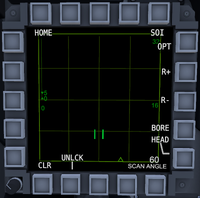
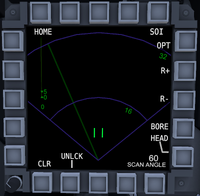
There are two available display modes for the radar: the standard PPI-Scope (Plan Position Indicator) and the B-Scope. Both are identical in function yet different in terms of layout and workflow.
Operation

To use a radar, the pilot must first press the SOI (Sensor of Interest) button, usually located in the top right corner of the RADAR page. The pilot will then be able to slew around the two parallel green lines, known as the TAC (Target Acquisition Cursor) with the VR controller's thumbstick.

When a target is found, the TAC, can be navigated onto a detected target and, by pressing down on the thumbstick, can engage a TWS (Track While Scan) lock on the target. Clicking the target again switches it to a STT (Single Target Track) lock.

The radar scans with a 120 deg/s (degrees per second) scan rate, resulting in the 60° scan angle mode (scanning between -60° and +60°) taking 1 second per full sweep, with the 30° and 15° angle modes taking 0.5 and 0.25 seconds respectively.


Range and Elevation

The radar elevation in SLEW mode, displaying its maximum, standard and minimum angles.

In SLEW mode, the radar elevation can be manually adjusted by moving the thumbstick up and down while holding the throttle. The numbers next to the two triangles represent the maximum and minimum altitude which is being scanned in. These numbers can vary with your aircraft's altitude and the TACs position.

The separate number below displays the radars vertical tilt in degrees, with its maximum elevation being +30° and -30°.

In the FORWARD mode, these adjustments are omitted entirely, with the radar instead gradually scanning in 4 bars of elevation, from bottom to top.

Scan Angle

The SCAN ANGLE button sets the horizontal limits of how far the radar will sweep: 60°, 30°, and 15°. As mentioned above, a lower scan angle results in more frequent sweeps over a more limited field of view.

In the SLEW mode, the scan area will appear on the MFD between two thick blue bounding lines. By moving the TAC against these bounding lines, the radar's field of view can be slewed left or right. Moving the TAC against the edge of the radar scope will also decrease the scan angle size and will loop back around to 60° after it reaches the smallest available angle.

Meanwhile, using the FORWARD mode will instead zoom in on the area in front of the aircraft, covering the entire length of the radar display. In this mode the radar cannot be slewed to the left or right.

TWS (Track While Scan)

An example image of a TWS track on multiple aircraft

In TWS mode, the radar is able to track up to 4 aerial targets at once. Targets locked in this mode are displayed from 1 to 4, in the order they were locked onto, on the radar. Each target can be individually switched between by pressing their associated number on the left side of the radar page.

A selected TWS target will be displayed as a PDT (Primary Designated Track) alongside its Bearing (B), Range (R), Altitude (A) and Mach Speed (M) in the bottom right corner of the radar screen. PDT is displayed in place of the aircraft type, as a TWS lock by itself is unable to identify the exact aircraft model.

In this mode, missiles such as the AIM-120C, AIM-120D and AIM-54 can be fired on and guided towards multiple different targets at once.


Marking a target in TWS results in the radars scan rate getting slower for each subsequent target marked. See the table and calculations below.

Radar scan rate and scan angle duration in TWS mode
Number of Targets Scan Rate 60° Scan Angle 30° Scan Angle 15° Scan Angle
0 Targets 120 deg/s 1 Second 0.5 Seconds 0.25 Seconds
1 Target 60 deg/s 2 Seconds 1 Second 0.5 Seconds
2 Targets 40 deg/s 3 Seconds 1.5 Seconds 0.75 Seconds
3 Targets 30 deg/s 4 Seconds 2 Seconds 1 Second
4 Targets 24 deg/s 5 Seconds 2.5 Seconds 1.25 Seconds

The formula for calculating the scan rate with n tracked targets is r=120/(n+1), with n being the number of targets marked and r being the scan rate in degrees per second.

To get the time for a full scan you use the formula t=(a*2)/r, with t being the time in seconds and a being the scan angle in degrees, and r being the previously calculated scan rate.

STT (Single Target Track)

A picture of a STT lock on the radar page.

In STT mode, the radar focuses a considerable amount of its power on a single target to get a powerful lock.

While not strictly necessary for most air-to-air missiles, it does give them considerably faster tracking updates as opposed to TWS mode and also displays the model of aircraft that is being locked in the target information section at bottom right corner of the screen. Additionally, locking a target will cause a steering dot (or pipper gunsight for guns) to appear, indicating the best way to maneuver to ensure the highest likelihood of a hit.


The radar is capable of maintaining tracks of TWS targets while in STT mode but is unable to spot or acquire new targets until the current STT target is unlocked.

HOJ (Home-On-Jam)

Home-On-Jam operates by locking an incoming jamming source on the radar screen and using noise analysis to determine the approximate elevation and azimuth of the jamming source.

To lock a jamming source, the pilot needs to slew the TAC over a jamming signal, marked as short, green bars on the screen and press down on the thumbstick to achieve a lock. Once locked, the jamming signals will accumulate on a long bar and the text "HOJ" will appear besides the lock.

In this mode, a missile will attempt to fly towards the approximate direction of the jamming source and, if available, use its on-board radar to detect and lock the airborne jamming threat once it has located it.

Any radar guided air-to-air missile such as the AIM-7, AIM-120C/D and AIM-54, as well as any anti-radiation missile like the AGM-88, AGM-88S, AGM-188 and AGM-126 can be guided in this mode.

Boresight

In Boresight, the radar will STT lock onto the first target it detects in a roughly 15 degree cone, regardless of range. This function is available in Fixed mode (BORE), where the radar search cone is fixed to the nose, or Headtrack mode (HEAD), where the search cone scans wherever the pilot is looking with the Helmet-Mounted Cueing System.

Headtrack mode can also be activated by clicking and holding the right thumbstick while the Radar page is the selected SOI. This allows the pilot to search for and lock a target while remaining "heads-up", such as during a dogfight.

Clicking and holding the right thumbstick again will return the radar to search mode.

Enemies will only receive RWR pings while they are within the boresight mode scan cone, making it a valuable tool for reducing your radar emissions.

Unlike the boresight mode of some of it's real-life counterparts, there are no range limitations on VTOL's boresight mode, and is able to detect and lock targets as far as the standard scan mode can.

MFD Options

The Options section on the radar MFD pages is only available on the F/A-26B and T-55. The options are listed below.

  • DISPLAY:
    • PPI (Plan Position Indicator)
    • B-Scope
  • FOV MODE:
    • FORWARD
    • SLEW
  • CURSOR SPEED:
    • 40
    • 60
    • 80
    • 100